
RVDB database, protein version
Current release — v32.0
Release date: 2026-07
Build date: 2026-07-03
HMM profiles & annotations
13,679 profiles
HMM profiles 254.2 MB
SQLite annotations 6.0 MB
TXT annotations 4.8 MB
Tools
CD-HIT 4.8.1 · HMMER 3.3.1 · BLAST+ 2.10.0 · MAFFT 7.526 · SILIX 1.2.11 · Python 3.11.11
Description
Reference Viral Databases (RVDB-prot and RVDB-prot-HMM) were developed to enhance virus detection using next-generation sequencing (NGS) technologies.
They were built by Thomas Bigot in Marc Eloit’s Pathogen Discovery group, in collaboration with the Bioinformatics and Biostatistics Hub at Institut Pasteur. They are based on the reference Viral Database, courtesy of Arifa Khan’s group at CBER, FDA: https://rvdb.dbi.udel.edu/.
They are updated after each new release of the nucleotide database. The version number of the protein databases follows that of the original nucleotide database.
Please note: the protein version is based on the unclustered (prefix “U-”) version of RVDB.
All versions
Full = unclustered protein sequences · Unique = clustered at 100% identity · Profiles = HMM profiles · Annotations = SQLite + plain text files
| Release | Date | Full | Unique | Profiles | Annotations |
|---|---|---|---|---|---|
| 32.0 | 2026-07 | FASTA | FASTA | HMM | SQLite TXT |
| 31.0 | 2026-01 | FASTA | FASTA | HMM | SQLite TXT |
| 30.0 | 2025-06 | FASTA | FASTA | HMM | SQLite TXT |
| 29.0 | 2024-08 | FASTA | FASTA | HMM | SQLite TXT |
| 28.0 | 2023-11 | FASTA | Not available | HMM | SQLite TXT |
| 27.0 | 2023-09 | FASTA | Not available | HMM | SQLite TXT |
| 26.0 | 2023-04 | FASTA | Not available | HMM | SQLite TXT |
| 25.0 | 2022-12 | FASTA | Not available | HMM | SQLite TXT |
| 24.1 | 2022-08 | FASTA | Not available | HMM | SQLite TXT |
| 23.0 | 2021-12 | FASTA | Not available | HMM | SQLite TXT |
| 22.0 | 2021-07 | FASTA | Not available | HMM | SQLite TXT |
| 21.0 | 2021-02 | FASTA | Not available | HMM | SQLite TXT |
| 20.0 | 2020-09 | FASTA | Not available | HMM | SQLite TXT |
| 19.0 | 2020-06 | FASTA | Not available | HMM | SQLite TXT |
| 18.0 | 2020-03 | FASTA | Not available | HMM | SQLite TXT |
| 17.0 | 2019-11 | FASTA | Not available | HMM | SQLite TXT |
| 16.0 | 2019-06 | FASTA | Not available | HMM | SQLite TXT |
| 15.1 | 2019-02 | FASTA | Not available | HMM | SQLite TXT |
| 14.0 | 2018-09 | FASTA | Not available | HMM | SQLite TXT |
| 13.0 | 2018-06 | FASTA | Not available | Not available | Not available |
| 12.2 | 2018-03 | FASTA | Not available | HMM | SQLite TXT |
| 11.5 | 2017-10 | FASTA | Not available | HMM | SQLite TXT |
| 10.2 | 2017-04 | FASTA | Not available | HMM | SQLite TXT |
Annotations
The annotation database assigns functional and taxonomic context to every HMM profile family. It is available both as a SQLite database and as tab-delimited text files.
SQLite schema
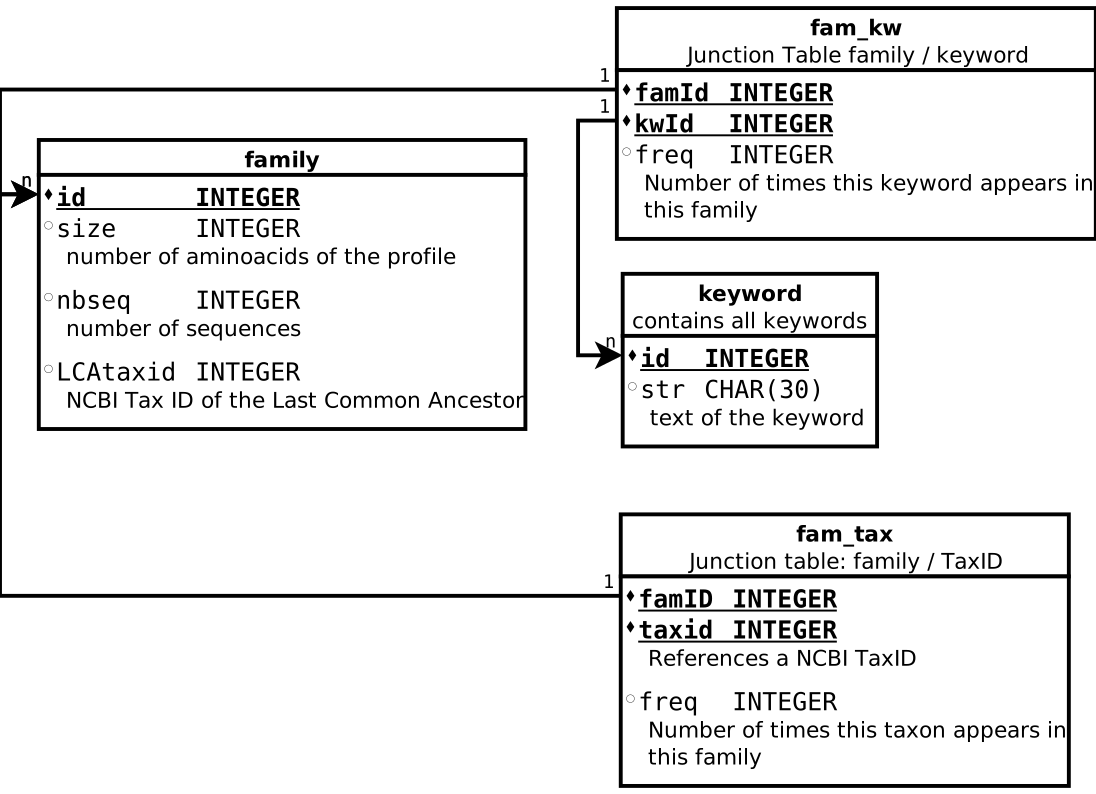
| Table | Type | Description | Key columns |
|---|---|---|---|
family |
Entity | HMM profile family | id, size, nbseq, LCAtaxid |
keyword |
Entity | Controlled vocabulary of keywords | id, str |
fam_kw |
Junction | Keyword frequencies per family | famId, kwId, freq |
fam_tax |
Junction | Taxon frequencies per family | famID, taxid, freq |
Example queries
1. Top keywords for one family
-- List the 10 most frequent keywords for family ID 5
SELECT k.str, fk.freq
FROM fam_kw fk
JOIN keyword k ON fk.kwId = k.id
WHERE fk.famId = 5
ORDER BY fk.freq DESC
LIMIT 10;
2. Largest families
-- List the 10 largest HMM families by number of sequences
SELECT id, size, nbseq, LCAtaxid
FROM family
ORDER BY nbseq DESC
LIMIT 10;
3. Taxonomic composition of a family
-- List taxa associated with family ID 5, ordered by frequency
SELECT taxid, freq
FROM fam_tax
WHERE famID = 5
ORDER BY freq DESC;
4. Families associated with a keyword
-- Count families and total occurrences for the keyword "Influenza"
SELECT COUNT(DISTINCT fk.famId) AS family_count,
       SUM(fk.freq) AS total_occurrences
FROM fam_kw fk
JOIN keyword k ON fk.kwId = k.id
WHERE k.str = 'Influenza';
Plain-text alternative: if you prefer not to use SQLite, the same annotations are provided as tab-delimited text files in U-RVDBvX.X-prot-hmm-txt.tar.xz.
Method
RVDB-prot is produced by a Snakemake pipeline that converts the nucleotide RVDB release into protein sequences, clusters them, builds HMM profiles and annotates every family. The source code is available on Institut Pasteur GitLab.
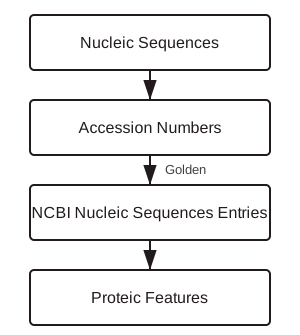
From nucleotide RVDB to protein flat file
For every entry of the nucleotide RVDB release, the corresponding protein coding sequences are extracted from GenBank/RefSeq records. Each FASTA header keeps a trace of both the protein and the original nucleotide record:
>acc|<p_bank>|<p_acc>|<n_bank>|<n_acc>|<descr[sp]>
where p_bank / p_acc identify the protein source, n_bank / n_acc the original nucleotide source, and descr[sp] the protein description and species.
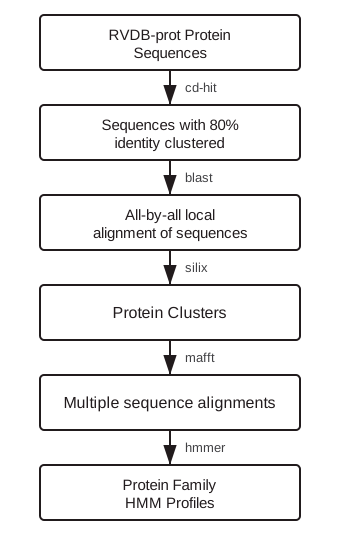
Clustering and HMM profile generation
The workflow was inspired by vFAM (Skewes-Cox et al.) and re-implemented as a Snakemake pipeline. Protein families are built and converted into HMM profiles through the following steps:
- Duplicate removal with CD-HIT at 100% identity.
- All-against-all comparison with BLAST+.
- Family definition with SiLiX from the similarity network.
- Filtering of clusters containing at least 4 sequences.
- Multiple sequence alignment with MAFFT in auto mode.
- HMM profile building with HMMER
hmmbuildusing default parameters.
Current build tools: CD-HIT 4.8.1, BLAST+ 2.10.0, SiLiX 1.2.11, MAFFT 7.526, HMMER 3.3.1 and Python 3.11.11.
Annotation of HMM profiles
Each HMM profile family is annotated by combining three sources of information:
- PFAM domains matched with HMMER using
--cut_ga, providing functional keywords. - Sequence descriptions used as a fallback when no PFAM hit is available.
- Taxonomic lineage summarized as a Last Common Ancestor (LCA) from NCBI TaxIDs.
See the Annotations section for the SQLite schema and example queries.